
Adviser Briefing: Critical Illness & Incapacity Benefits

What the MGIUL 24 critical-illness rider actually pays, the four covered conditions, where incapacity sits in the contract, and how to frame the living benefits for referring advisers and clients.

MGIUL 24 · Issued from Bermuda · Rider 25MGABRC · Product Guide LIFE-5082 07/24

1

Critical-illness rider

4

Covered conditions

US$5M

Acceleration ceiling

Senior financial adviser standing with arms folded in a private office, specialists in Manulife Global Indexed UL living-benefit planning

01 Summary

The position at a glance

MGIUL 24 carries one critical-illness living benefit — the Accelerated Death Benefit for Critical Illness Rider (form 25MGABRC). There is no standalone incapacity, disability, total permanent disability or waiver-of-premium benefit on the product.

The position in five lines

  • One critical-illness living benefit — the Accelerated Death Benefit for Critical Illness Rider (form 25MGABRC)
  • No standalone incapacity, disability, TPD or waiver-of-premium benefit on the product
  • Incapacity appears only as a diagnostic threshold — the Activities of Daily Living test — inside the critical-illness definitions
  • A separate living benefit, the Accelerated Benefit Rider (Terminal Illness), sits on the contract and is distinct from the critical-illness rider
  • Both living benefits draw on a single, shared acceleration ceiling
Every one of these benefits is an acceleration of the existing death benefit — none is an additional, ring-fenced sum assured. Any critical-illness figure shown on an illustration is a maximum draw against the death benefit, not a defined payout in addition to it.
The single most important framing pointMGIUL 24 · Adviser Briefing

The Rider In Detail

Answers you can take to a client meeting

Six questions advisers ask most often about the MGIUL 24 living benefits — with the insight, the talking point, and the objection handling behind each one.

01

What is the critical illness rider, and what does it actually do?

Talking Point

“Every one of these benefits is an acceleration of the existing death benefit — none is an additional, ring-fenced sum assured.”

Adviser Insight
The rider accelerates a portion of the policy's death benefit on diagnosis of a covered condition. The claim must be made voluntarily by the policyowner and is not payable to, or on behalf of, a creditor. Manulife may amend the list of conditions and their definitions at its discretion, with notice.
No Separate Sum Assured
The benefit is drawn from the death benefit — never paid in addition to it. Any critical-illness figure on an illustration is a maximum draw, not a defined payout.
No Rider Charge
The rider carries no premium charge or monthly deduction of its own.
02

How high is the diagnostic gate?

Talking Point

“This is a narrow, end-stage schedule of four conditions — not the 30–50+ conditions, frequently paid at first diagnosis, found in a standalone critical-illness policy.”

Adviser Insight
“Critical Illness” means a diagnosis expected to result in death within five years — end-stage conditions, not a UK-style first-diagnosis menu.
Objection Handling
“Doesn't this cover critical illness like my UK plan?” — No. The severity thresholds are materially higher and the schedule is materially narrower.
03

How much is available on a valid claim?

Talking Point

“The amount available depends on policy value at the time of claim — not on a fixed sum agreed at outset.”

Adviser Insight
The maximum is the lesser of 80% of policy value less any policy debt, or US$5,000,000 — then reduced by any amount previously accelerated under any other rider on the policy.
Early-Years Implication
In the early years of a 15- or 20-pay structure — before material cash value has built — the amount available can sit well below the fixed critical-illness sum a client may be expecting. The 80% ceiling bites on a small base.
Minimum & Frequency
No payment is made below US$50,000, and the benefit is a single lump sum paid once only.
04

Does MGIUL 24 pay on incapacity or disability?

Talking Point

“Incapacity can only ever produce an acceleration of the death benefit — never an independent incapacity payout.”

Adviser Insight
No. MGIUL 24 provides no standalone incapacity, disability, TPD or waiver-of-premium benefit. Nothing in the product pays out, or waives premium, on incapacity as such.
Where It Does Appear
Functional incapacity enters the contract only as a diagnostic gate: the inability to perform at least 2 of the 6 Activities of Daily Living for a continuous 6 months within Stroke with Severe Impairment, and the end-stage physiological thresholds within Permanent Organ Damage.
Planning Point
Where a client's priority is genuine disability or income-protection-style cover, that must be sourced outside MGIUL.
05

How does the terminal illness benefit interact with the critical illness rider?

Talking Point

“The two living benefits share one acceleration ceiling.”

Adviser Insight
The Accelerated Benefit Rider (Terminal Illness) is elected at application, available to all applicants regardless of age with no additional underwriting. It triggers on a life expectancy of one year or less and pays 100% of policy value less policy debt, up to US$2,000,000.
Interaction
Because the critical-illness ceiling is net of “amounts previously accelerated under any other rider”, a prior terminal-illness acceleration reduces what remains available under the critical-illness rider — and vice versa.
Default Protection
The death benefit and policy value reduce by the amount paid, and the same 60-month default-protection window applies.
06

What happens if the life insured dies before the accelerated benefit is paid?

Talking Point

“Acceleration is a one-way event: the policy is permanently smaller afterwards, and the rider cannot be used again.”

Adviser Insight
If the life insured dies after the benefit is invoked but before it is paid, Manulife cancels the acceleration and pays the death benefit instead.
Definition
“Physician” means an M.D. or D.O. acting within the scope of their licence. A binding third-opinion mechanism resolves any difference of medical opinion.

02 Conditions of Payment

What Manulife requires before an accelerated benefit is paid

01

Due Proof of critical illness — written notice of a physician's diagnosis. Manulife may require clinical, radiological, histological and laboratory evidence, and may require (at its expense) an examination by a physician of its choice.

02

A binding third-opinion mechanism resolves any difference of medical opinion between the claimant's physician and Manulife's.

03

Written consent of any irrevocable beneficiary or assignee.

04

A completed claim form. Manulife issues one within 15 days of the request; if it does not, Due Proof may be submitted in writing without the form.

05

Death Benefit Option 1 in effect — or changed to Option 1 as part of the claim.

06

The claim must be made voluntarily by the policyowner, and is not payable to, or on behalf of, a creditor.

Adviser Tip: if the life insured dies after the benefit is invoked but before it is paid, Manulife cancels the acceleration and pays the death benefit instead.

03 Benefit Amount & Effect

What is available, and what payment costs the policy

The Eligible Death Benefit

On approval of a valid claim, the maximum amount available is the lesser of two ceilings — then reduced by any amount previously accelerated under any other rider on the policy.

The two living benefits share a single acceleration ceiling, so a prior terminal-illness acceleration directly reduces what remains available under the critical-illness rider.

Because the benefit is policy-value-driven, the amount available in the early years of a 15- or 20-pay structure can sit well below the fixed critical-illness sum a client may be expecting.

Benefit Amount — the two ceilings

Ceiling A — 80%
Of Policy Value minus any Policy Debt.
Ceiling B — US$5M
Absolute maximum acceleration under the rider.
Minimum — US$50k
No payment is made below this amount.
Payment — Once
A single lump sum, paid once only.
Net of prior acceleration
Reduced by any amount previously accelerated under any other rider on the policy.

What payment does to the policy

On payment of the accelerated benefit, six consequences follow — and none of them is reversible.

Acceleration is a one-way event: the policy is permanently smaller afterwards, and the rider cannot be used again.

The rider terminates on payment, on policy termination, or on the policyowner's written request — with no repeat-claim facility, even if the amount paid was less than the Eligible Death Benefit.

Six consequences of payment

Pro-rata reduction
Death Benefit, Total Face Amount, Policy Value, Cash Surrender Value and Cumulative Guarantee Policy Value (and any Death Benefit Protection Value) reduce pro rata to the acceleration.
Cost of Insurance recalculated
COI is recalculated on the lower Net Amount at Risk.
Surrender charges partly waived
Charges arising solely from the related Base Face Amount decrease are waived; any remaining surrender charge reduces proportionately.
Future increases cancelled
Any future death-benefit increases under supplementary riders are cancelled.
Early-Lapse Protection replaced
Early-Lapse Protection terminates; in its place, for 60 months following payment the policy will not go into default solely because Net Cash Surrender Value falls to zero or below.
The rider terminates
No repeat claim is available, even where the amount paid was less than the Eligible Death Benefit.

04 Covered Conditions

Four conditions. End-stage thresholds.

This is a narrow, end-stage schedule of four conditions — not the 30–50+ conditions, frequently paid at first diagnosis, found in a standalone critical-illness policy.

ConditionTrigger standard (per rider definitions)Principal exclusions
Cancer with Metastasis (Stage IV only)All Stage IV malignant tumour with the presence of distant metastasis; the diagnosis of malignancy must be confirmed by histological evidence.Leukaemias and lymphomas unless non-responsive to treatment; all tumours in the presence of HIV infection.
Severe Heart AttackDeath of heart muscle from coronary artery occlusion or obstruction, diagnosed to international standards, with — at least 6 months after the event — either NYHA Class IV functional limitation or LVEF below 30%.Angina; heart attack of indeterminate age.
Stroke with Severe ImpairmentA cerebrovascular incident causing permanent neurological deficit such that the insured cannot perform (aided or unaided) at least 2 of the 6 Activities of Daily Living for a continuous 6-month period; supported by MRI, CT or comparable imaging.Transient ischaemic attacks; brain damage from accident, injury, infection, vasculitis or inflammatory disease; vascular disease of the eye or optic nerve; ischaemic vestibular disorders; secondary haemorrhage within a pre-existing lesion.
Permanent Damage to Heart, Lungs, Liver and KidneysEnd-stage organ failure at defined thresholds: heart — ejection fraction persistently below 30% (echocardiogram, at least 6 months post-event); lungs — FEV below 30% with PaO₂ below 50 mmHg (at least 6 weeks); kidneys — eGFR below 15 ml/min/1.73 m² with ACR above 300 mg/g (persisting at least 6 months); liver — end-stage failure with permanent jaundice, ascites and hepatic encephalopathy.Heart and liver damage secondary to alcohol or drug use is excluded.

05 Incapacity & Terminal Illness

Where incapacity sits in the contract

Directly on the point: MGIUL 24 provides no standalone incapacity, disability, TPD or waiver-of-premium benefit. This matrix sets out each living benefit on the contract, its trigger, its ceiling, and what it does not do.

BenefitTriggerAmountNotes
Accelerated Death Benefit for Critical Illness (25MGABRC)Diagnosis of one of four defined conditions at end-stage severityLesser of 80% of policy value less debt, or US$5,000,000Single lump sum; minimum US$50,000; rider terminates on payment
Accelerated Benefit Rider (Terminal Illness)Life expectancy of one year or less, evidenced by a licensed medical doctor100% of policy value less policy debt, up to US$2,000,000Elected at application; all ages; no additional underwriting
Standalone incapacity / disability benefitNot available on MGIUL 24NoneMust be sourced outside MGIUL where it is a client priority
Waiver of premium on incapacityNot available on MGIUL 24NoneNo premium is waived on incapacity as such
ADL-based incapacity testInability to perform at least 2 of the 6 Activities of Daily Living for 6 continuous monthsAcceleration only, within Stroke with Severe ImpairmentA diagnostic gate — never an independent incapacity payout

06 Adviser Positioning

How to frame it for clients

Lead with what it is not

Not a standalone critical-illness policy, not a fixed critical-illness sum, and not an incapacity or disability benefit.

On an illustration

Present life cover at its face amount and describe the critical-illness rider as an available acceleration feature.

If a critical-illness figure appears

Explain an illustrative figure (e.g. US$1,250,000) as the maximum draw against the death benefit at the point of claim — capped at the lesser of 80% of policy value less debt or US$5,000,000.

Set expectations on breadth

Four conditions, end-stage thresholds, a single payment — not a first-diagnosis menu of 30–50+ conditions.

Where dedicated cover is a priority

Recommend a separate standalone critical-illness or disability policy alongside MGIUL.

Frame the early years

Before material cash value has built, the amount available can sit well below the sum a client may be expecting.

Suggested form of words

“MGIUL includes an Accelerated Death Benefit for Critical Illness rider, which can advance up to the lesser of 80% of policy value (less debt) or US$5,000,000 if the life insured is diagnosed with one of four defined conditions at end-stage severity. This is not a standalone critical-illness policy: the benefit is drawn from the death benefit rather than paid in addition to it, it is a single payment, and the amount available depends on policy value at the time of claim. There is no separate incapacity or disability benefit. Where dedicated critical-illness or disability cover is a priority, a separate policy alongside MGIUL should be considered.”

07 Source Documentation

Reconciled line-by-line against the rider wording

Form 25MGABRC

Accelerated Death Benefit for Critical Illness Rider — definitive on the critical-illness rider, including the Section 3 list of conditions and the Appendix definitions.

LIFE-5082 07/24

Manulife Global Indexed UL Product Guide — Accelerated Benefit Rider (Terminal Illness) terms.

Product parameters are current as at the July 2024 product-guide publication where material to the answer.

Adviser-Only Briefing

Critical Illness & Incapacity Benefits — Manulife Global Indexed UL

Download the full adviser briefing, developed by Capital for Life.

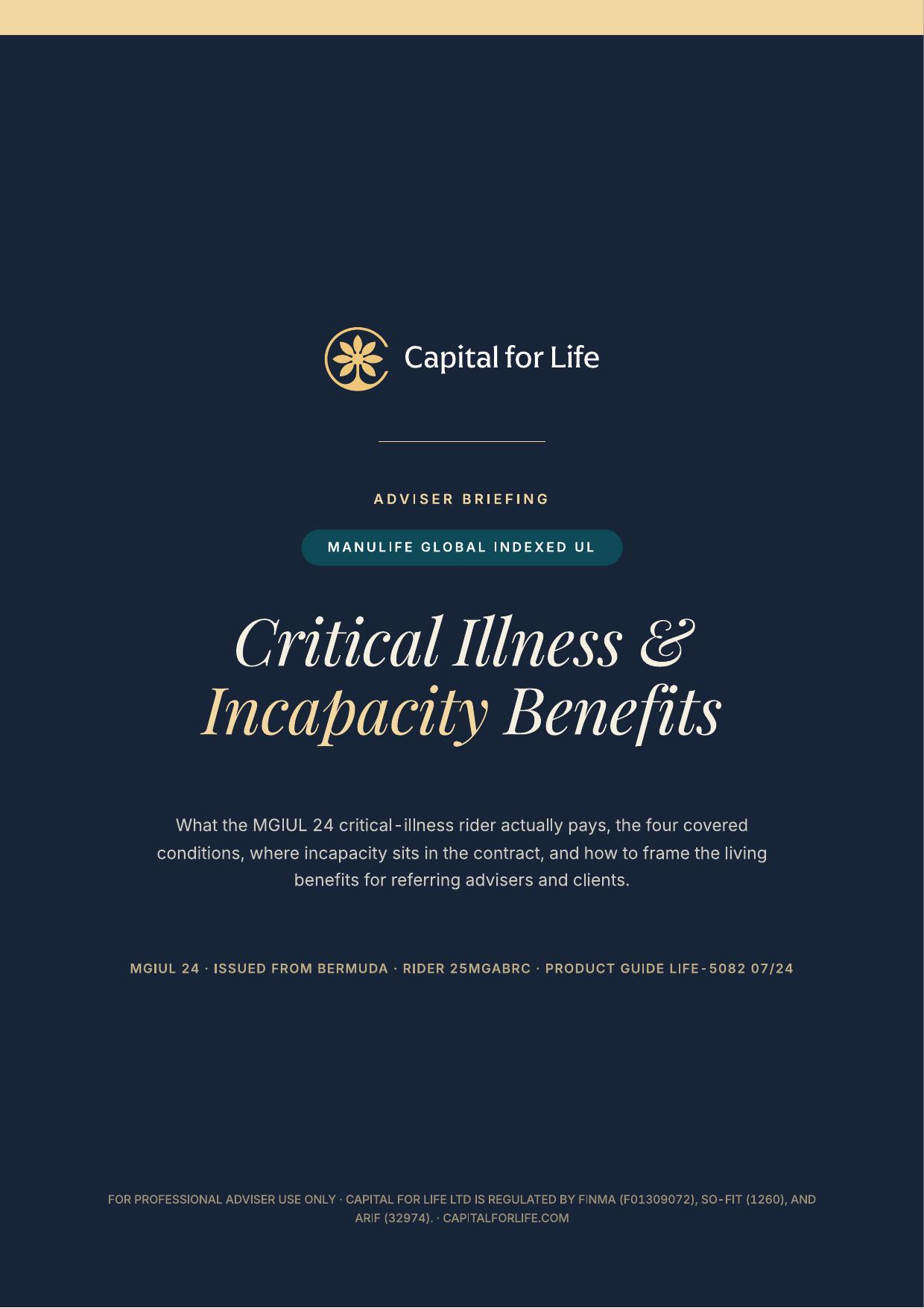
Front cover of the Capital for Life adviser briefing: Critical Illness and Incapacity Benefits under Manulife Global Indexed UL (MGIUL 24)