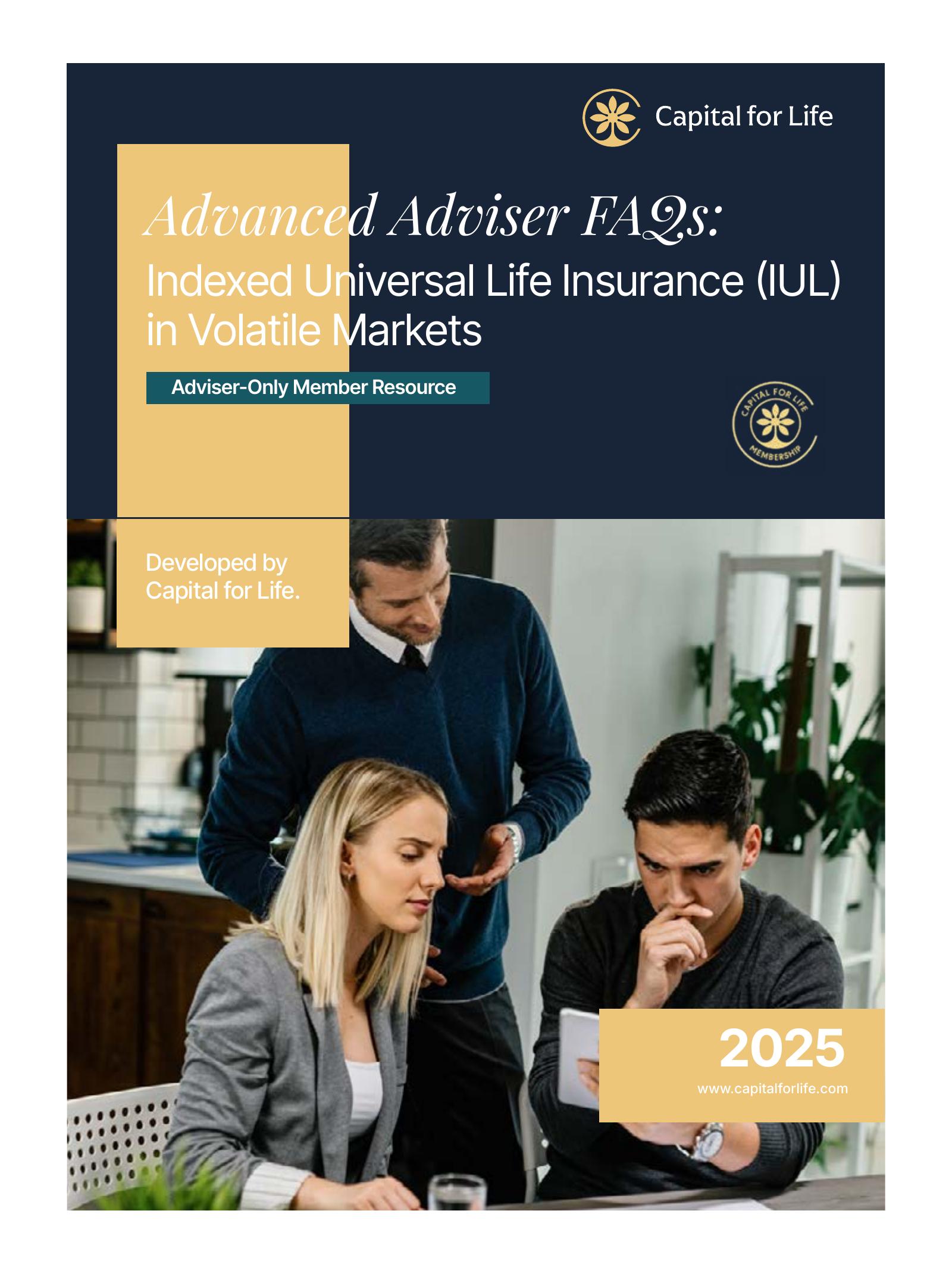
Advanced Adviser FAQs: Indexed Universal Life Insurance in Volatile Markets

A practical FAQ guide for financial advisers positioning IUL to high-net-worth clients concerned about market volatility, retirement income, and legacy planning.

Developed by Capital for Life · 2025 edition

0%

Downside floor

Annual

Index gain reset

20 pages

Adviser-only resource

Financial adviser explaining indexed universal life insurance volatility protection to two high-net-worth clients reviewing policy illustrations on a tablet

Introduction

Built for advisers positioning IUL

This expanded FAQ guide is intended for financial advisers and other trusted advisers who are positioning Indexed Universal Life Insurance (IUL) to high-net-worth clients concerned about market volatility, retirement income, and legacy planning.

It includes

  • Adviser-ready talking points
  • Common client objections and responses
  • Structuring insights for suitability and planning
  • Case-style use cases to deepen understanding
  • Member-only links to sample Reason Why Documentation for client reporting
I've had the pleasure to work with Carlton and the whole team on a number of occasions. I've found them very professional and thorough when preparing UL cases for my clients.
James GormleyFinsbury, Dubai

Advanced Adviser FAQs

Answers you can take to a client meeting

Nine of the questions advisers are asked most often about IUL in volatile and stagnant markets — with the insight, the talking point, and the objection handling behind each one.

01

How does IUL compare to ETFs and mutual funds during market stagnation?

Talking Point

“IUL wins by not losing.”

Adviser Insight
Most portfolios underperform during sideways decades due to volatility drag and behavioural mistakes (e.g. selling low). IUL prevents panic selling and volatility drawdowns.
Tax Advantage Add-on
Unlike mutual funds, IUL grows tax-deferred and rebalances with tax-free cost.
Structuring Tip
Compare a $1,000,000 ETF holding with a $1,000,000 IUL projection over 15 years. Assuming a flat market over that period, IUL may come out ahead depending on market upswings and cost of insurance drag.
02

Is IUL good in volatile markets?

Talking Point

“Market swings give IUL more chances to gain and zero chances to lose.”

Adviser Insight
Volatility increases the chances of annual resets, locking in short-term gains, while the zero floor avoids losses. This “volatility capture” effect favours IUL performance in range-bound or high-variance markets.
Structuring Tip
Recommend IUL for clients with non-qualified cash reserves who aren't yet drawing income but want optionality.
03

Can IUL protect against bear markets?

Talking Point

“When others lose 30%, your client holds steady. That stability is a powerful planning asset.”

Adviser Insight
During bear markets, IUL crediting may be 0%, but it avoids the drawdowns suffered by equity investors. This provides a buffer during multi-year declines, preserving gains and cash value.
Use Case
Your client retires into a bear market. IUL cash value becomes a safe withdrawal source while markets recover.
Objection Handling
“But equities always bounce back.” — True, but bouncing back from a 50% loss requires a 100% gain. IUL avoids falling in the first place.
04

What is the ‘zero floor’ in an IUL policy?

Talking Point

“It's your client's market shock absorber.”

Adviser Insight
This feature prevents negative returns in years the index drops. It protects the client's capital and enhances cumulative compounding.
Example Phrase for Clients
“You'll never see a negative return from the index, guaranteed for life* — zero is your worst-case scenario.”
Note
*Some next-generation IUL policies have limited downside protection, so make sure you understand the policy differences before you recommend it to a high-net-worth client.
05

What does ‘annual reset’ mean in an IUL?

Adviser Insight
Each year, the index's performance resets. Gains are locked in as the new base. This allows for long-term compound growth even when markets are choppy and volatile.
Client Analogy
“Imagine your yearly gains are steps — and you never have to step backwards.”
Structuring Tip
Reset mechanics can work especially well when the policy is funded heavily in the early years.
06

What happens if the stock market goes sideways for 10 years?

Talking Point

“In a flat or choppy market, IUL still earns in up years and never gives those gains back.”

Adviser Insight
Sideways markets (e.g. 2000–2010 S&P 500) often result in actual losses once fees, taxes, and inflation are accounted for. For clients drawing income, this compounds sequence risk.
IUL Advantage
The zero floor protects against down years, and the annual reset locks in gains from positive years. Over a 10-year stagnation, IUL may achieve positive growth even if the index finishes flat.
Client Scenario
A retired client taking income from a 60/40 portfolio from 2000–2010 versus holding some funds in IUL — the outcome is significantly more stable with IUL.
Objection Handling
“What if the market eventually comes back?” — Yes, but the problem isn't just if it recovers, it's when. IUL removes the risk of waiting too long to recover losses.
07

Is IUL better than annuities for downside protection?

Talking Point

“IUL is like a safety net with a growth engine and an estate plan wrapped in one.”

Adviser Insight
Annuities offer guarantees but often lack flexibility. IUL combines downside protection with greater liquidity, tax-free growth and a death benefit.
When to Recommend
High-net-worth clients averse to annuity lockups.
Objection Handling
“But annuities offer income.” — That's their strength, but IUL can generate income, provide access to cash for the rest of your life, and provide growth potential, plus leaving a high death benefit for loved ones.
08

Is IUL suitable for retirement income planning?

Adviser Insight
IUL can supplement any retirement plan (e.g. 401(k)s, SIPPs, QNUPS, superannuation schemes) by offering tax-free growth, less sequence returns risk, portfolio diversification and an alternative income when equities fall.
Key Uses
Bridge income before traditional pension access dates; leave a legacy for estate planning; a strategic asset for high-income earners hitting pension caps or limits.
Suitability Tip
Show IUL as part of a bucket strategy, not a standalone plan.
09

Can IUL mitigate sequence of returns risk?

Adviser Insight
Yes. Sequence of returns risk is neutralised by the 0% floor preventing early losses, locked-in gains avoiding drawdowns and gain clawbacks, and a tax-efficient policy structure that reduces tax drag.
Client Message
“The wrong returns at the wrong time can destroy a financial plan. IUL buffers against that with certainty.”

Client Profiling

What types of clients are best suited for IUL in volatile or stagnant markets?

01

High-income earners with excess cash flow

02

Pre-retirees maxing out other allowances

03

High-net-worth clients seeking to increase their legacy by leaving a high cash death benefit

04

Estate planning clients seeking tax planning payment options

05

Risk-averse clients concerned about stock market crashes

Adviser Tip: IUL should be positioned as part of a coordinated financial plan, not a product replacement. Blend it with core holdings to reduce volatility and enhance optionality.

Definition Boxes

The concepts behind the conversation

What Is Sequence of Returns Risk?

Sequence of returns risk refers to the risk that the timing of investment returns, especially early in retirement, may adversely impact the sustainability of your portfolio.

Two individuals with identical average returns over 20 years may have significantly different financial outcomes if one suffers poor returns in the first few years of retirement. This can lead to faster asset depletion, particularly when withdrawals are made during periods of negative or flat market performance.

The IUL policy helps mitigate this risk by providing a stable, protected asset from which withdrawals can be made, preserving growth assets until markets recover.

Key Benefits of IUL Against Sequence Risk

0% Floor
Ensures your policy never suffers a market-based loss, protecting your capital during downturns.
Annual Reset
Locks in each year's gains, creating a compounding effect regardless of future market drops.
Tax-Advantaged Withdrawals
Allows for income often without triggering additional tax burdens.
Market Timing Protection
Acts as a buffer asset, reducing the need to sell equities during poor markets.

What Is Market Volatility?

Market volatility refers to the rate at which the price of securities increases or decreases over a given period. It is commonly used as a measure of market uncertainty or risk.

High volatility means prices can change dramatically in a short time period, both upward and downward, which can create anxiety for investors, particularly during retirement or legacy planning phases.

IUL helps manage this risk by offering protection during market downturns and locking in growth when markets are favourable, creating a smoother return profile over time.

Key Benefits of IUL in Volatile Markets

0% Floor
Eliminates market losses during negative years, helping preserve capital.
Annual Reset
Locks in gains annually and protects them from future volatility.
Upside Index Participation
Allows you to benefit from market growth up to a cap, while avoiding downturns.
Behavioural Protection
Reduces your emotional reaction to market fluctuations, promoting long-term consistency.

What Is a Bear Market?

A bear market is typically defined as a decline of 20% or more in a major market index such as the S&P 500, sustained over a period of time.

Bear markets are often accompanied by economic recessions, reduced investor confidence, and heightened volatility. For investors, bear markets risk significant capital loss, especially if assets are liquidated during downturns.

Indexed Universal Life policies help mitigate this risk by shielding policyholders from downside exposure while allowing market-linked upside during recoveries.

Key Benefits of IUL in Bear Market Conditions

0% Floor
Shields your capital from index-linked losses during extended market declines.
Annual Reset
Protects past gains, ensuring they are not erased by subsequent downturns.
Non-Correlated Asset
Provides balance to equity-heavy portfolios, reducing overall volatility and drawdown.
Accessible Liquidity
Enables tax-efficient access to funds without needing to sell depressed assets.

Using IUL for Retirement Income Planning

Indexed Universal Life policies are permanent life insurance contracts that accumulate tax-deferred cash value linked to the performance of a market index (e.g. S&P 500), subject to a cap and a 0% floor.

When structured correctly, IUL policies can allow policyholders to access the cash value via tax-free policy loans or withdrawals. This makes IUL a flexible and tax-advantaged component of retirement income planning, particularly for high-net-worth individuals with taxable assets, pension restrictions, or global structuring needs.

IUL can complement other pension-based retirement income strategies, especially for those subject to limits and caps on their traditional retirement savings vehicles.

Key Benefits of IUL for Retirement Income

Lower Sequence Returns Risk
Significantly reduces the risk that taking income from your investment portfolio when the market drops could mean you run out of money.
Tax-Advantaged Withdrawals
Enables access to income without triggering tax liabilities (if structured correctly).
0% Floor
Ensures that market downturns don't reduce your available income.
Annual Reset
Locks in gains year-on-year, building stable income potential.
No Contribution Limits
Allows for greater funding flexibility than traditional pension solutions.
Legacy + Liquidity
Provides both income for life and a death benefit at passing, supporting family and legacy goals.

Comparison

Why this matters for you — IUL and ETFs

IULs and ETFs can work effectively together. However, IULs play a unique role in offering downside protection, liquidity, and tax-advantaged legacy benefits — none of which are available through ETF-only strategies.

FeatureETFsIndexed Universal Life (IUL)
Market Downturn RiskFully exposed to lossesProtected by 0% floor
TaxationCapital gains and dividends taxableTax-deferred growth and tax-free access (when structured properly)
Liquidity During VolatilityMust sell units, possibly at a lossLoans/withdrawals available without liquidating at a loss
Legacy PlanningNo built-in benefitIntegrated death benefit for guaranteed higher estate value
Behavioural Risk (Selling Low)High during crashesAvoided due to built-in protection and smoothing effect

Client Suitability Summary

Reason Why Matrix – Indexed Universal Life (IUL)

This matrix helps advisers quickly assess where IUL may be suitable within a high-net-worth client's financial plan — for suitability reports, compliance notes, or proposal justifications.

Client ScenarioPlanning ObjectiveWhy IUL FitsPlanning Themes
Approaching RetirementPreserve capital and reduce sequence riskOffers downside protection and tax-advantaged income drawdown optionsRetirement, Protection
In Retirement (Decumulation)Maintain income sustainabilityMitigates sequence of returns risk and smooths withdrawalsRetirement, Protection
High EarnersSupplement restricted retirement contributionsAllows unrestricted funding with tax-deferred growth and estate benefitsWealth Accumulation, Tax Planning
Concerned About Market CrashesProtect capital in severe downturnsProtects principal via 0% floor and locked-in gainsProtection, Capital Preservation
Tax-Sensitive InvestorsReduce tax drag and manage cash flowEnables tax-deferred growth and tax-free access (when structured properly)Tax Planning, Efficiency
Wants DiversificationAdd non-correlated asset to portfolioOffers growth and downside protection uncorrelated with traditional assetsDiversification, Portfolio Hedging
Estate Planning MotivatedEnhance tax-efficient intergenerational transferIncludes death benefit and can be placed in trust or estate structuresEstate Planning, Wealth Transfer
Cross-Border or Globally MobileMaintain portability and planning flexibilityInternationally portable and adaptable for global planningGlobal Mobility, International Planning
Seeking Wealth CreationEnhance estate value on a guaranteed basisProvides immediate estate uplift with cost-effective death benefitWealth Creation, Estate Planning
Asset Class DiversificationHedge against equity and bond volatilityAdds smoothing, low-correlation component to traditional portfoliosDiversification, Risk Management
Risk-Averse InvestorsAvoid exposure to full market downsideGuarantees capital protection and stable growthRisk Management, Stability

Adviser Prompts

Ask these questions

Approaching Retirement

Has the client indicated concern over future volatility or sequencing risk?

In Retirement (Decumulation)

Is the client currently drawing income from volatile assets and worried about sustainability?

High Earners

Has the client exceeded pension or retirement plan contribution limits and is seeking alternatives?

Concerned About Market Crashes

Has the client previously experienced major market losses or expressed fear of another crash?

Tax-Sensitive Investors

Is the client facing significant annual tax bills on dividends, investment income, or capital gains?

Wants Diversification

Does the client already hold traditional assets (e.g. equities, fixed income) and want to diversify?

Estate Planning Motivated

Has the client raised questions about inheritance, trusts, or tax-efficient wealth transfer?

Cross-Border or Globally Mobile

Does the client live or work across multiple tax jurisdictions or plan to retire abroad?

Seeking Wealth Creation Through Protection

Is the client motivated by legacy growth or seeking to create guaranteed wealth for beneficiaries?

Asset Class Diversification

Is the client looking to reduce equity exposure or add a safe, smoothing asset to their portfolio?

Risk-Averse Investors

Has the client expressed low tolerance for market risk or an emotional aversion to loss?

Adviser-Only Membership Resource

Advanced Adviser FAQs: Indexed Universal Life Insurance in Volatile Markets

Download the full 20-page guide, developed by Capital for Life.

Front cover of the Capital for Life white paper: Advanced Adviser FAQs on Indexed Universal Life Insurance in volatile markets