

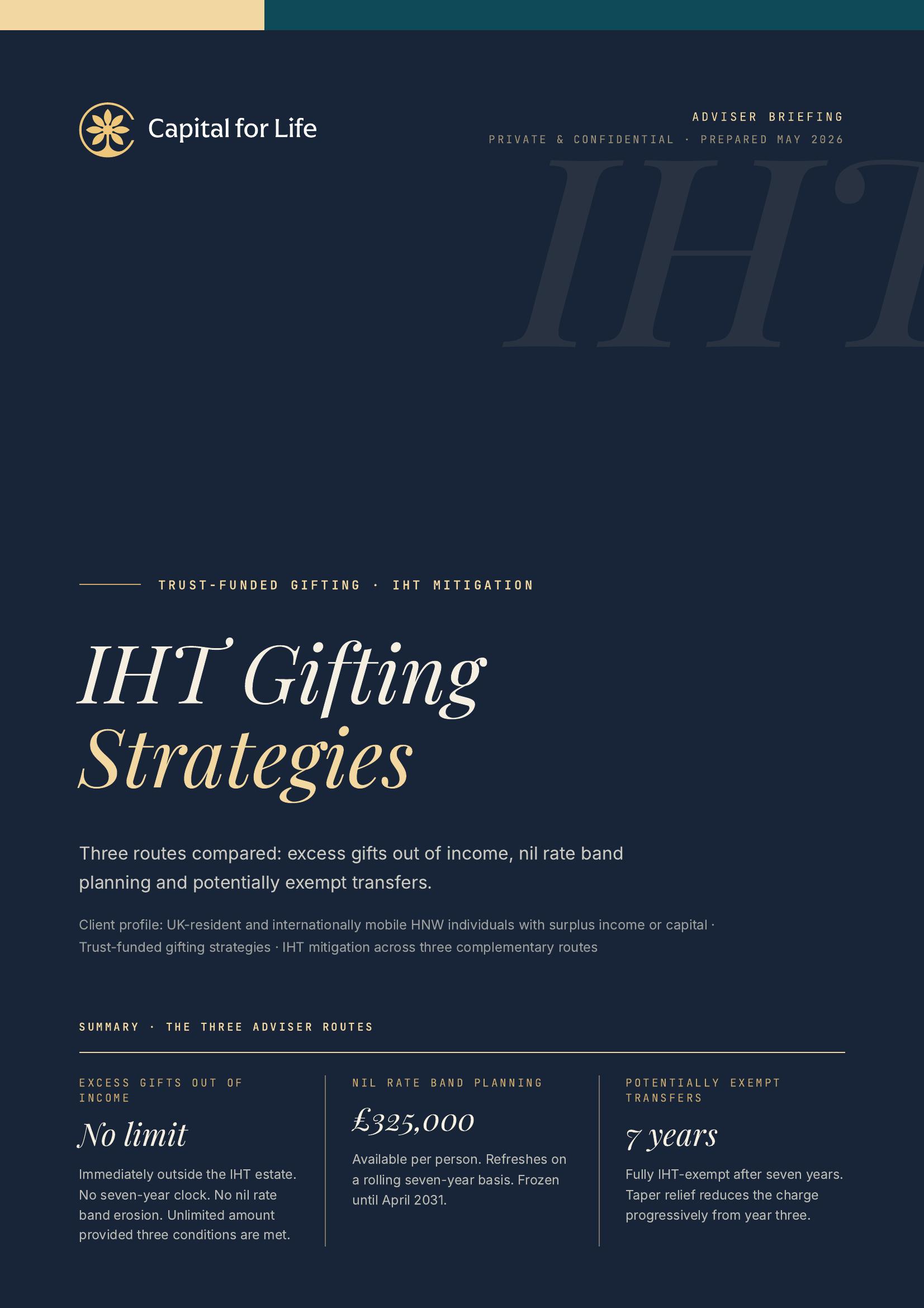
IHT Gifting Strategies

Three routes compared: excess gifts out of income, nil rate band planning and potentially exempt transfers.

Client profile: UK-resident and internationally mobile HNW individuals with surplus income or capital · Prepared May 2026

No limit

Excess gifts out of income

£325,000

Nil rate band, per person

7 years

PET exemption clock

Sunlight between modern city office towers, representing wealth structuring and inheritance tax planning

The three adviser questions

Every HNW client with surplus income or available capital faces the same structural question: which gifting route delivers the best IHT outcome, and in what sequence? The three routes covered in this briefing operate independently and can run simultaneously. The practical discipline is different for each.

  • The three conditions for the s.21 normal expenditure exemption
  • Worked example: premium-funded IUL in discretionary trust
  • Nil rate band refresh on a rolling seven-year cycle
  • Taper relief table and the 14-year shadow
  • Decision table by client profile and a full risk register
s.21 first: no clock, no limit, no nil rate band impact. Then the nil rate band for any capital available, refreshing every seven years. Then PETs for any balance.
Carlton Crabbe, Founder and CEO of Capital for LifeCarlton CrabbeFounder and Chief Executive Officer · Capital for Life Ltd

Three routes, one sequence

The insight, the talking point and the structuring discipline behind each of the three gifting routes available to a UK-resident HNW client.

01

Excess gifts out of income — IHTA 1984 s.21

Talking Point

“The strongest route for clients with predictable surplus income.”

Adviser Insight
The normal expenditure out of income exemption removes qualifying gifts from the IHT estate immediately and with no upper limit. Unlike a PET it does not run a seven-year clock; unlike a CLT it does not consume the nil rate band.
Structuring Tip
For premium-funded life insurance in discretionary trust, this is typically the most efficient funding route available. Maintain the IHT403 schedule annually from year one.
Key Exclusion
5% withdrawals from offshore bonds and insurance wrappers are a return of capital, not income — even where they give rise to a chargeable event gain. Including them is the most common error in s.21 planning.
02

Nil rate band planning — chargeable lifetime transfers

Talking Point

“£325,000 per person, refreshing every seven years.”

Adviser Insight
A gift into a discretionary trust is a CLT. Where it falls within the available nil rate band, the immediate charge is nil. The NRB is not a single-use allowance: it refreshes on a rolling seven-year cycle.
Structuring Tip
A disciplined CLT programme moves £975,000 per person into trust over 21 years with no entry charge, provided cumulation is monitored.
Relevant Property Regime
A charge of up to 6% of trust value above the available NRB applies at each ten-year anniversary. For a trust funded within the NRB the effective rate is typically well below 1% where growth has been moderate — materially lower than 40% IHT on death.
03

Potentially exempt transfers — the seven-year clock

Talking Point

“Taper relief reduces the rate of tax, not the value of the gift.”

Adviser Insight
A PET is a lifetime gift to an individual or to an absolute (bare) trust. It is not immediately chargeable and becomes fully IHT exempt after seven years. If the donor dies within seven years it becomes chargeable and forms part of the cumulation against the estate.
Mitigation
Decreasing term assurance written in trust is the natural companion structure, covering the diminishing charge in years one to seven.
Key Distinction
A gift into a discretionary trust is a CLT, not a PET. The trust type must be confirmed before the trust is established.

Excess gifts out of income

The normal expenditure out of income exemption removes qualifying gifts from the IHT estate immediately and with no upper limit. Unlike a PET, the gift does not run on a seven-year clock. Unlike a chargeable lifetime transfer, it does not consume the nil rate band. Three conditions must all be satisfied.

The three conditions in practice

1 · Regular pattern of giving
HMRC typically assesses a three to four year history. A single gift may qualify where the donor has made a documented commitment to continue. Written statements of intent and standing orders are useful evidence. Gifts need not go to the same recipient, provided they go to the same class of beneficiary.
2 · Paid from income, not capital
Income includes employment, pension drawdown, rental, dividends and interest received in cash. It does not include 5% withdrawals from offshore bonds or insurance wrappers — these are return of capital and must be excluded.
3 · Standard of living maintained
The donor's usual lifestyle must be sustainable from remaining income after gifts are made. A fall caused by an unforeseeable event does not automatically break the exemption for earlier gifts. A foreseeable reduction in income will break the condition for future gifts.

Record keeping: the exemption is claimed on death and HMRC may request evidence covering all gifts made in the seven years before death. Maintain records annually using the HMRC form IHT403 schedule as the benchmark.

Worked example · premium-funded IUL in discretionary trust

Annual net income (pension, dividends, rental)
£120,000
Annual living expenses
£72,000
Surplus income available for gifting
£48,000
Annual IUL premium funded from surplus income
£48,000
IHT saving at 40% per annum (s.21 accepted)
£19,200
Cumulative IHT saving over 10 years
£192,000

Nil rate band planning

A chargeable lifetime transfer is a gift into a discretionary trust. It is immediately chargeable — but where it falls within the available nil rate band, the immediate charge is nil. The NRB refreshes on a rolling seven-year cycle, making disciplined CLT planning a powerful long-term capital transfer strategy.

AllowanceAmountKey conditions
Nil rate band (NRB)£325,000Frozen until at least April 2031. Available to every individual. Unused NRB transferable to a surviving spouse or civil partner on death.
Residence nil rate band (RNRB)£175,000Available only where the family home passes to direct descendants on death. Tapers by £1 for every £2 above a £2m estate. Not available on lifetime CLTs.
Combined (couple, estate below £2m)£1,000,000Requires full NRB and RNRB from first death to be transferred. Both frozen until April 2031.

The seven-year refresh

All CLTs and failed PETs made in the preceding seven years are cumulated against the NRB. Once seven years have passed from the date of a CLT, that transfer falls out of the cumulation and NRB capacity is restored.

YearGift into trustSeven-year look-backNRB availableEntry charge
Year 1£325,000 CLTNo prior CLTs£325,000Nil
Year 8£325,000 CLTYear 1 CLT falls outside 7-year window£325,000 restoredNil
Year 15£325,000 CLTYear 8 CLT falls outside 7-year window£325,000 restoredNil
21-year total (per person)£975,000Nil

The relevant property regime: a charge of up to 6% of the trust value above the available NRB applies at each ten-year anniversary. For a trust funded within the NRB the effective rate is typically well below 1% where growth has been moderate — materially lower than 40% IHT on the same asset remaining in the estate at death. Exit charges apply on a proportionate basis.

Potentially exempt transfers and taper relief

A potentially exempt transfer is a lifetime gift to an individual or to an absolute (bare) trust. It is not immediately chargeable. If the donor survives seven years it becomes fully IHT exempt. If the donor dies within seven years, the PET becomes chargeable and forms part of the cumulation against the estate.

Where a failed PET is chargeable, taper relief reduces the rate of tax where the donor survived at least three years. Taper reduces the tax rate, not the value of the gift. It only saves tax where cumulative gifts exceed the nil rate band.

The 14-year shadow: a CLT made more than seven years before death falls outside the estate cumulation, but where that CLT was made within seven years of a PET it is brought back into account when calculating the NRB available to the failed PET. Example: Year 1 £325,000 CLT; Year 5 £500,000 PET; Year 10 death — the full £500,000 PET is chargeable at the taper rate for years 5–6 (16%).

Taper relief on failed PETs · IHTA 1984 s.7(4)

0 to 3 years
40%
3 to 4 years
32%
4 to 5 years
24%
5 to 6 years
16%
6 to 7 years
8%
7 years or more
Nil — fully exempt

Using all three together

The recommended sequence is determined by efficiency: channel as much as possible through the route with no upper limit and no clock first, then supplement with the NRB and PET routes for any balance.

Step 1 · s.21 first

No limit, no clock

Surplus income goes through s.21 before any other route. No clock, no NRB impact, no upper limit.

Step 2 · NRB planning

£325k every 7 yrs

A systematic CLT programme allows capital to enter discretionary trust without an entry charge on a rolling cycle.

Step 3 · PETs

7-year clock

Direct gifts to individuals or bare trusts. Life assurance in trust covers the diminishing charge.

Client profilePrimary routeSecondary routeNotes
Strong, predictable income surpluss.21 normal expenditureNRB CLT for capital injectionIHT403 maintained annually. Bond withdrawals excluded.
Capital available, limited income surplusNRB CLT into trustPET for balance above NRBNRB refreshes every 7 years. Life assurance covers PET risk.
Future access to capital requiredGift and loan trusts.21 for ongoing premiums5% allowance services the loan. Only growth sits outside the estate.
Younger client, long time horizonPET to individuals / bare trusts.21 if surplus income exists7-year clock most valuable over longer periods.
UHNW, multiple objectivesAll three in sequences.21 for premiums, NRB every 7 years, PETs for direct gifts.

Risk register

Each item should be assessed before the first gift and re-tested at every annual review.

s.21 claim rejected on death

Annual IHT403 records from year one. Three conditions tested each year. Written statement of intent at outset.

5% bond withdrawals included in surplus income

Bond withdrawals are return of capital. Exclude from the income calculation. Confirm annually that no capital receipts are included.

Income falls, disrupting the gifting pattern

Annual income review. Reduction documented at the time. A foreseeable fall breaks the standard-of-living test for future gifts.

Donor dies within 7 years of a PET

Decreasing term assurance written in trust covers the diminishing charge. Taper relief reduces exposure from year three.

Failed PET reduces the estate NRB

Monitor cumulative gifts annually. Prioritise s.21 to avoid NRB consumption. Review CLT/PET sequencing.

CLT exceeds the available NRB

20% entry charge on any excess. Monitor 7-year cumulation. Split the CLT across years or delay until the NRB refreshes.

Trust incorrectly administered

Experienced trustee appointed. Annual trustee review. Standing instructions for premium payments.

Tax law changes after gifts are made

Annual review. Rationale for the structure documented at outset and at each annual review.

Statutory references and conclusion

ReferenceSubject
IHTA 1984 s.21Normal expenditure out of income. Three conditions. Evidence on HMRC form IHT403.
IHTA 1984 s.3APotentially exempt transfers. Definition, conditions and treatment on death within seven years.
IHTA 1984 s.7 and s.7(4)Rates of IHT on lifetime transfers. Taper relief on failed PETs.
IHTA 1984 ss.19–21Lifetime exemptions including the annual exemption (£3,000) and normal expenditure out of income.
IHTA 1984 ss.58–85Relevant property regime. Discretionary trust charges: ten-year anniversary and exit charges.
HMRC IHTM14231Internal guidance on the normal expenditure out of income exemption: conditions and HMRC practice.
HMRC IHTM14255The standard-of-living condition. Treatment of commitments made before an unforeseen income fall.
HMRC form IHT403Operational record-keeping benchmark for income, expenditure and gifts. Completed annually.
FA (No. 2) 2024 / FA 2025Residence-based IHT regime in force from 6 April 2025. Long-term UK resident definition and reset rules.

s.21 is the first call on every client with surplus income. It is the only route that is immediately exempt, uncapped and entirely outside the seven-year cumulation.

The nil rate band is not a single-use allowance. £325,000 per person can enter discretionary trust every seven years at no entry charge.

PETs are the appropriate route for direct gifts to individuals or bare trusts where the client is in good health, with life assurance in trust as the companion structure.

IHT Gifting Strategies: the full adviser briefing

Download the complete PDF, prepared May 2026 by Capital for Life.

Front cover of the Capital for Life adviser briefing: IHT Gifting Strategies