
China's 20% Offshore Trust Tax: The 90 Day Window and Where PPLI Genuinely Fits

Announcement No. 21 of 2026 brings offshore trusts within Chinese individual income tax, with a 90 day disclosure window already running. What advisers, trustees and family offices need to do now — and the role life insurance genuinely plays.

Carlton Crabbe, Founder and Chief Executive, Capital for Life · Published 25 July 2026

Download the PDF
20%
Entry and annual charge
90 days
Disclosure window, running
×2
Express insurance carve out
Financial advisers and a trustee reviewing offshore trust documents against a Shanghai skyline, discussing China's new 20% offshore trust tax under Announcement No. 21 of 2026

The whole position, before the detail.

On 24 July 2026 China's Ministry of Finance and State Taxation Administration issued Announcement No. 21 of 2026, bringing offshore trusts within individual income tax. Chinese tax residents now pay 20% on gains when assets go into an offshore trust, and 20% annually on income arising inside it and inside entities the trust controls, whether or not anything is distributed.

Historic amounts back to January 2023 must be declared within a 90 day window during which late payment surcharges are waived; settlements made before 2023 escape retroactive collection of the establishment charge.

Private placement life insurance has a genuine role in the response, including an express carve out that appears twice in the announcement itself — which most early commentary has missed — but a narrower and more defensible role than much of the market is about to claim.

It includes

  • What the announcement charges, on the way in and while it runs
  • The 90 day catch-up window and the pre-2023 legacy relief
  • Why the deferral claim is not settled Chinese law
  • The express carve out for regulated insurers' products — twice
  • A ninety second triage you can run across the whole book

The official Q&A presents the announcement as implementing the existing principle that Chinese residents are taxable on worldwide income — greater certainty and enforceability, not new law. That tells you the direction of travel, and it tells you that positions built on ambiguity have a short shelf life.

Carlton Crabbe

Founder & CEO, Capital for Life

Nine answers you can take into a client meeting

The rules were issued jointly by the MOF and STA, dated and effective 24 July 2026, accompanied by an official questions and answers release. Article references are to the announcement unless stated.

01Article 3

What is charged on the way in?

Talking point

20% on market value less original cost — the charge follows the disposal, not the wrapper.

Adviser insight

Gains on transferring shares, property or other assets into an offshore trust are taxed as income from transfer of property at 20% on market value less original cost and reasonable expenses, with the asset's base cost then rebased to market value.

Structuring tip

Establish first whether the client sits on cash or on low base cost assets. A cash premium involves no disposal and no gain; transferring low base cost shares into anything — trust or policy alike — crystallises 20%.
02Article 4

What is charged while the trust runs?

Talking point

20% annually on the resident settlor — whether or not anything is distributed.

Adviser insight

Income arising during the trust's life — in the trust itself or in offshore entities the trust holds, controls or manages — is taxed annually at 20% on the resident settlor, as property transfer income or as interest, dividends and bonuses. Income taxed annually is not taxed again on later distribution.

Watch the base

Losses cannot be carried forward, the two categories cannot offset each other, and trustee remuneration, trust management fees, legal fees and investment advisory fees are not deductible.

03Article 8

What about trusts settled by non-residents?

Talking point

Chinese resident beneficiaries are taxed at 20% on the market value received.

Adviser insight

Distributions of trust property to Chinese resident beneficiaries from trusts settled by non-residents are taxed at 20% on the market value received, as interest, dividends and bonuses.

Use case

Resident beneficiaries of a parent's or grandparent's non-resident-settled trust now have a live liability on every receipt, even where they have never been near the structure's administration.

04Article 12

Do benefits in kind count?

Talking point

Guarantees, loans left outstanding and free use of trust property are deemed distributions.

Adviser insight

Using trust assets to guarantee or secure a resident's borrowing, lending to a resident and leaving it outstanding at year end, paying or reimbursing a resident's expenses, or allowing free or under priced use of trust property are all deemed distributions, taxed on the resident at market value.

Screening question

Ask what the family actually uses: the London flat, the credit line secured on the portfolio, the school fees paid from the trust. Each is now a taxable event.

05Articles 5–7

What happens on the way out?

Talking point

Termination, emigration and death are each clearance events.

Adviser insight

Termination triggers a clearance charge on liquidation gains as interest, dividends and bonuses. A resident settlor who becomes non-resident is deemed to realise the trust property that day, taxed on market value less base cost.

Trustee obligation

Where a resident settlor dies and the trust passes to a non-resident or no successor, the trustee or its designated domestic institution must file and pay on the deemed gain at death.

06Articles 2, 9, 11

How wide is the anti-avoidance net?

Talking point

One resident co-settlor makes the whole trust resident settled.

Adviser insight

Property settled through nominees but funded, borne or controlled by an individual is treated as settled by that individual. Where residents and non-residents settle the same trust, the whole trust is treated as resident settled.

The client who thinks he is out

Individuals who have taken foreign citizenship or overseas residence but keep their main economic interests in China may be determined to be China domiciled residents. These are the clients most likely to be wrong about their position.

07Article 17

How does the 90 day catch-up window work?

Talking point

Historic amounts back to January 2023, declared with late payment surcharges waived.

Adviser insight

Unpaid tax on property settled by residents between 1 January 2023 and 31 December 2025, and on trust income received before 2026, must be declared within 90 days of implementation with late payment surcharges waived. An extended recovery period is possible for larger amounts.

The legacy relief

The retroactive establishment charge does not reach settlements made before January 2023 — official media describe this as relief for trusts operating more than three years — though lifetime income remains reportable whenever the trust was settled.

08Article 10

Is foreign tax creditable?

Talking point

Compute the credit before disclosing, not after.

Adviser insight

Tax of an individual income tax nature already paid abroad on the trust under local law is creditable against the Chinese liability when declaring under the announcement.

Structuring tip

Clients whose trusts have suffered equivalent tax offshore should quantify the actual liability with the credit applied. Nobody should overpay the window out of haste.

09Article 15

What does the permanent calendar look like?

Talking point

Annual filings 1 March to 30 June; 15 day event filings thereafter.

Adviser insight

From 1 January 2026 settlements and annual trust income are declared between 1 March and 30 June of the following year; terminations, deaths and changes of residence status are declared within 15 days of the following month. Where payment is genuinely difficult, tax on terminations and deaths may be paid in equal instalments over five years.

The cost of missing it

A late payment surcharge of 0.05% per day — roughly 18% a year — with fines of 50% to 500% of unpaid tax for evasion and possible criminal referral in serious cases. The window is one off; the compliance cycle is not.

What the annual charge costs

Twenty years of the 20% charge.

A Chinese resident client holds a US$20m portfolio in a BVI trust, returning 5% a year.

The true position is worse than the table: trustee fees, management charges, legal and investment advisory costs are not deductible from the taxable base, losses cannot be carried forward, and the two income categories cannot be netted against each other.

A client looking at figures of that size over twenty years will pay for a rigorous answer — which is exactly why the quality of the answer now matters.

10 year cost

≈US$2.97m

20 year cost

≈US$9.24m

The arithmetic

Gross returnNet after 20% annual IIT
Annual return5.0%4.0%
Value after 10 yearsUS$32.58mUS$29.60m
Value after 20 yearsUS$53.07mUS$43.82m

The charge follows the disposal, not the wrapper

RouteGain crystallisedCharge at 20%
Transfer US$10m of shares (base cost US$2m) into a trustUS$8mUS$1.6m
Sell the shares, settle cash on trustUS$8mUS$1.6m
Pay a US$10m cash premium from existing liquidityNilNil

What is settled, and what is not.

Advisers will be pitched insurance wrappers as the answer to these rules, usually on the claim that policy growth is deferred from the 20% charge. Before repeating that claim to a client, it is worth knowing what Chinese counsel will say when they check it. There is no published Chinese rule, ruling or guidance giving an offshore life policy's internal growth deferral for Chinese individual income tax purposes.

Not settledIrrelevant to the analysisCertain
Deferral of a policy's internal growth for Chinese IIT purposesThe carrier's jurisdiction — Bermuda, Barbados, Dublin or LuxembourgCRS visibility, already used to open enquiries
An argument for counsel on specific facts, never a product featureChina characterises the contract under Chinese law, wherever the insurer sitsCRS 2.0 rolling out from 2026 in the BVI and Cayman Islands
No published Chinese rule, ruling or guidance grants itTreaty benefits run to the insurer's investment income, not the policyholderExpected to reach Singapore and Hong Kong within two to three years

None of this diminishes the opportunity. It defines it. The advisers who win this work will be the ones whose analysis survives contact with the client's Chinese counsel.

The solution

What a policy genuinely delivers under these rules.

Four benefits hold on any reading of the new rules.

First · Entry without a disposal charge where funding is cash

Cash premiumNo disposal, no gain, no 20% entry charge.
Appreciated assets20% crystallises on transfer into any structure.
First questionCash or low base cost assets — before any wrapper discussion.

Second · Regulated insurance products are expressly carved out — twice

Article 1Expressly excludes financial products issued by regulated banks, insurers, securities firms and fund houses from the "foreign legal arrangement" limb.
Article 13Repeats the exclusion in the look-through rules: licensed financial institutions meeting the same tests are not "offshore entities".
State it preciselyA materially better position than an explicitly taxed one — not a blanket safe harbour.

Third and fourth · Succession certainty and statutory protection

SuccessionA death benefit is a defined contractual sum to named beneficiaries: no probate across jurisdictions, no trustee discretion, no grant of representation.
BermudaThe Segregated Accounts Companies Act 2000 ring fences policy assets by statute.
Luxembourg and IrelandThe triangle of security gives first ranking priority over segregated assets; Solvency II protections are comparably real under a different mechanism.
Why it holdsThese protections do not depend on Chinese characterisation at all.

Under China's new rules, PPLI offers entry without a disposal charge where funding is cash, an express carve out from the trust regime's definitions for regulated insurers' products, contractual succession outside probate, and statutory insurer level asset protection. It is cleanest where the policyholder is not, or genuinely ceases to be, a Chinese tax resident.

The problem

Run the book against these profiles

Every profile below now carries either a filing obligation, a live liability, or both — and the 90 day window applies to all of them at once. The screening cannot wait for the client to raise it.

Chinese Resident Settlors

Of any offshore trust, wherever it sits — Cayman, BVI, Jersey, Guernsey, Hong Kong, Singapore. Split the file before and after January 2023.

Resident Beneficiaries

Of trusts settled by non-residents. Distributions are taxed at 20% on receipt — and so are benefits in kind.

Mixed Settlor Trusts

One resident co-settlor causes the whole trust to be treated as resident settled.

Hong Kong Listed Holdings

Bureaus in Shanghai, Shenzhen and Jiangsu have demanded offshore trust income details since early 2025, applying a 20% levy in cases pursued.

Second Passport Holders

Clients who took overseas residence but kept their business, family and economic centre in China. Most likely to believe they are outside the net.

Family Offices and Trustees

In Dubai, Singapore and Hong Kong administering China linked wealth — trustees now carry direct filing obligations on a settlor's death.

What to do in the next 90 days.

1

Screen the book

Identify every trust with a Chinese resident settlor, beneficiary, protector or controlling person — including foreign passport holders whose economic centre remains China.

2

Get the disclosure question answered first

Whether and how to use the 90 day window is a matter for Chinese counsel, and it is the client's most urgent, time limited decision.

3

Quantify with credits

Compute the actual liability before disclosing, applying the Article 10 credit for equivalent tax already paid offshore.

4

Establish the funding position

Cash or appreciated assets. This determines what is genuinely available.

5

Diarise the permanent calendar

Annual filings each 1 March to 30 June, 15 day event filings on terminations, deaths and residence changes, and the five year instalment option.

6

Then discuss structure

On the basis set out above — with the tax position grounded rather than assumed.

China's 20% Offshore Trust Tax: The 90 Day Window and Where PPLI Genuinely Fits

Download the full 16-page technical briefing, developed by Capital for Life.

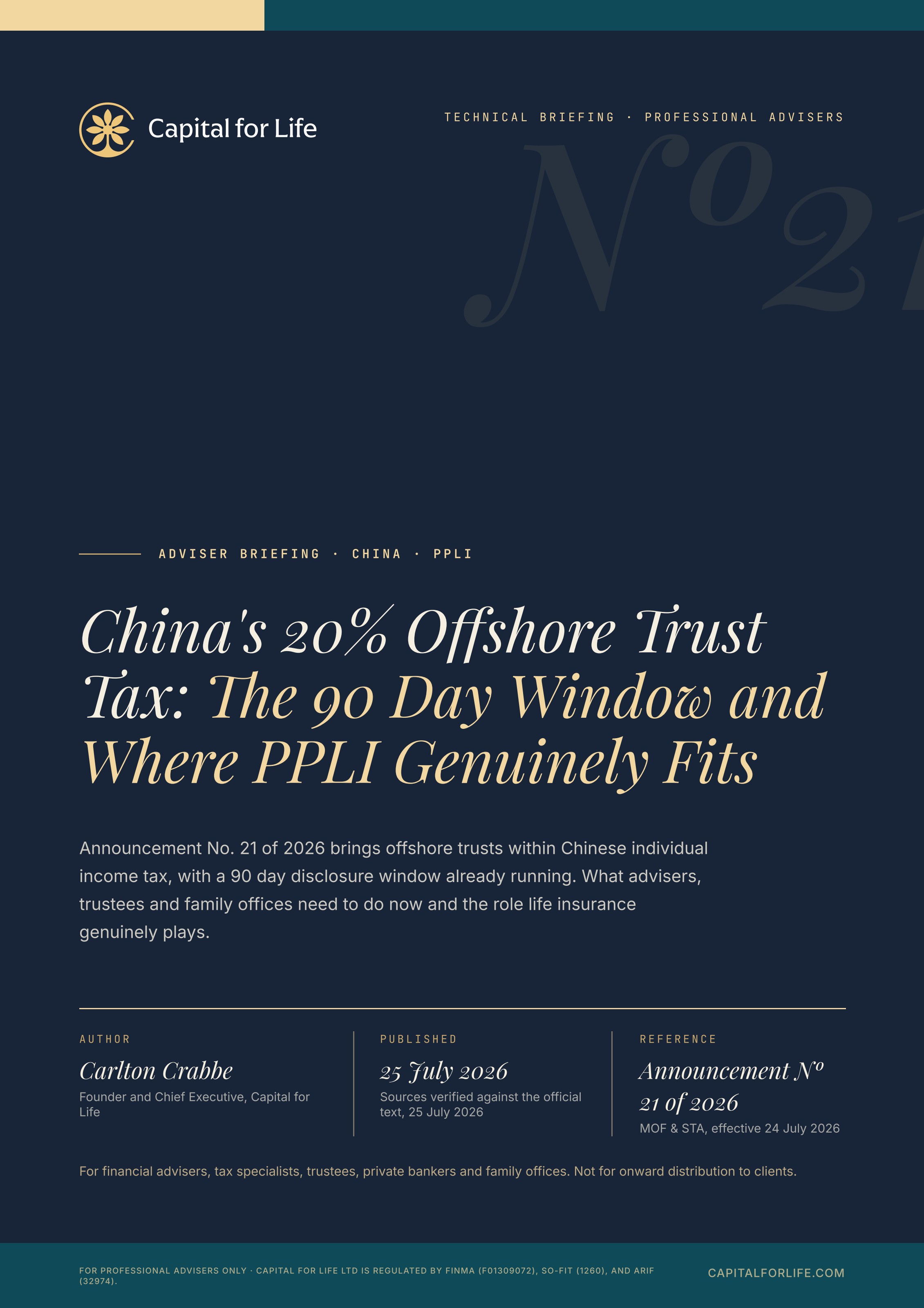
Front cover of the Capital for Life technical adviser briefing: China's 20% Offshore Trust Tax — The 90 Day Window and Where PPLI Genuinely Fits